
connecting future treatments to today’s patients
Evolving disease management in IPF and PPF

Current state of care for IPF and PPF
Disease management remains challenging
IPF and PPF are not only complex conditions to diagnose and manage but challenging to develop new treatments for as well. Over the past years, many drug development programs have faced substantial difficulty bringing new products through clinical trials to market. Despite ongoing research, no new treatments have been approved in the last decade.1
The following management options are currently available for patients with IPF or PPF:

Including antifibrotics (IPF/PPF), immunomodulators (PPF), and
anti-inflammatories (PPF)

For eligible IPF and PPF patients at high risk for death and high survival probability

For eligible IPF and PPF patients when oxygen saturation falls below 88%
Response to these therapeutic options varies widely, and both disease-related and treatment-related factors can impact patient adherence or management decisions.6
Changing management landscape for IPF and PPF
Expert guidance for the management of IPF and PPF
A changing management landscape for IPF and PPF creates forward momentum in the care physicians can deliver to their patients.1,7
ATS/ERS/JRS/ALAT 2022 Clinical Practice Guidelines8
IPF
- Update to radiological and histopathological criteria for IPF diagnosis
- Conditional recommendation against treating IPF with antacid medication or antireflux surgery
- Criteria for defining PPF (evidence of 2 of 3 criteria: worsening of symptoms, radiologic progression, physiologic progression)
- Conditional recommendation for nintedanib
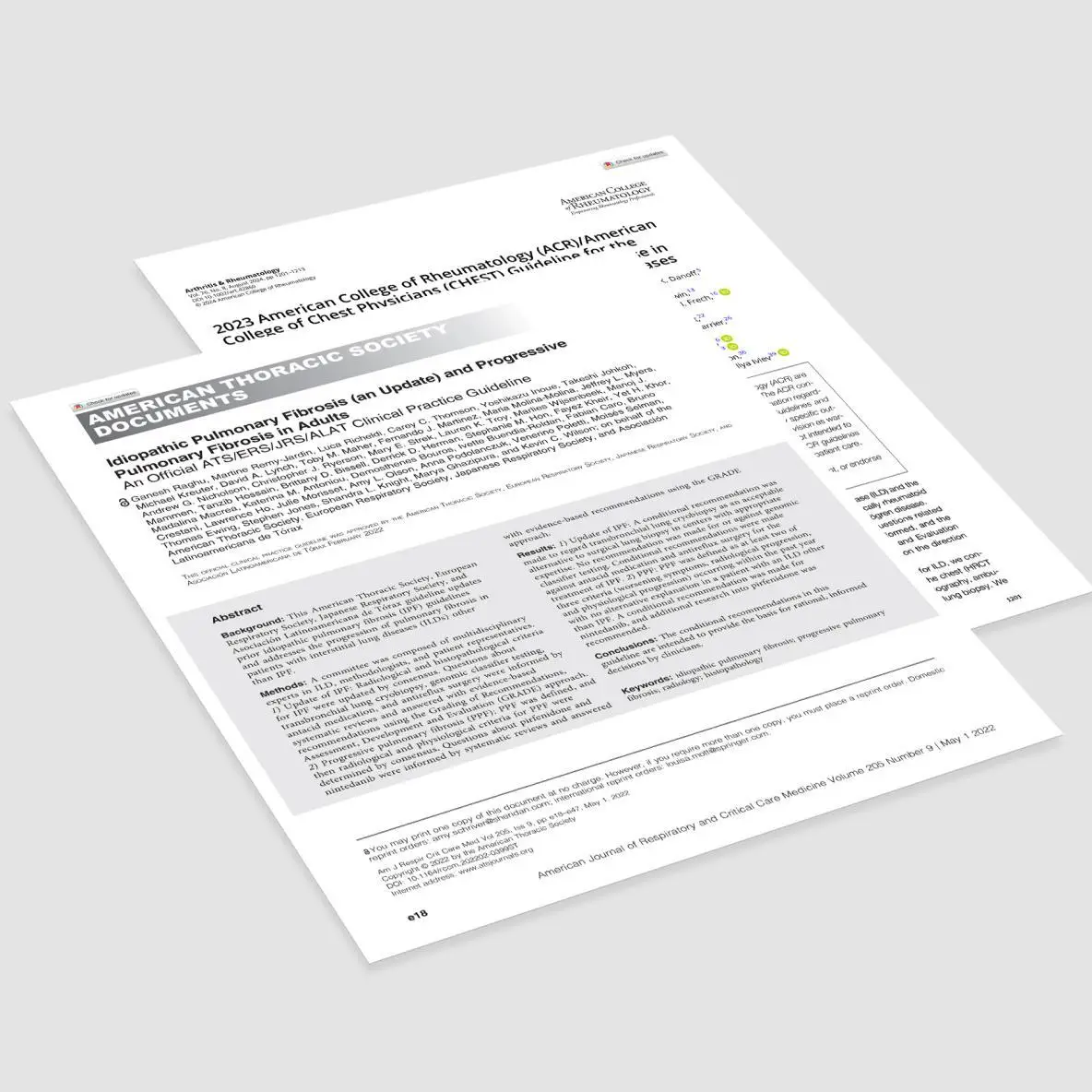
ACR 2023 Guidelines9
As first-line ILD treatment options, ACR conditionally recommends:
SARD-ILDs except SSc-ILD
- For: mycophenolate, azathioprine, rituximab, and cyclophosphamide
- Against: leflunomide, methotrexate, TNFi, and abatacept, pirfenidone, IVIG or plasma exchange
SSc-ILD
- For: tocilizumab, nintedanib
- Against: glucocorticoids
RA-ILD
- No consensus reached on recommendations
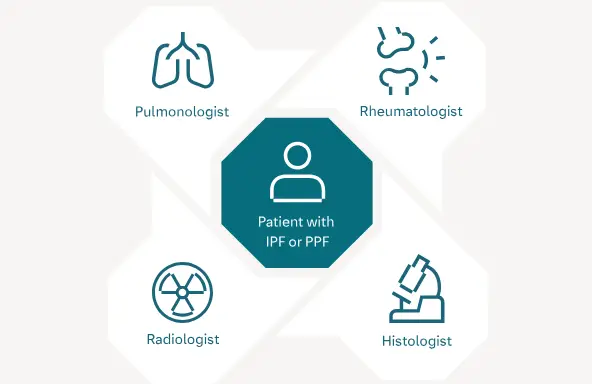
Collaborative care across multiple clinical areas is key for early and accurate monitoring, diagnosis, and management of PF10-12
The importance of collaboration across multiple specialties remains essential to optimal care, especially for patients with CTD-ILDs.7
In a Canadian study of patients with fibrotic ILDs, collaborative care team discussions led to changes in management in ~40% of patients (n=50/126)13
- Includes medical therapy, lung biopsy, and change in medical treatment13
Collaborative care model 10,11

Commitment to the future
In the management of these progressive diseases, physicians aspire to do more for their patients. Here’s how we’re hoping to move forward.
Looking ahead for IPF and PPF

Seeking further understanding of the complex interplay between inflammation and fibrosis in the progression of PF

Aspiring to a standard of care that elevates the patient experience while helping reduce lung function decline

Supporting physicians as they redefine what better care can look like for their patients with IPF and PPF
ACR, American College of Rheumatology; ALAT, Latin American Thoracic Association; ATS, American Thoracic Society; CTD-ILD, connective tissue disease- associated interstitial lung disease; ERS, European Respiratory Society; FVC, forced vital capacity; IPF, idiopathic pulmonary fibrosis; JRS, Japanese Respiratory Society; PF, pulmonary fibrosis; PPF, progressive pulmonary fibrosis; RA-ILD, Rheumatoid Arthritis-associated Interstitial Lung Disease; SARD-ILD, systemic autoimmune rheumatic diseases with interstitial lung disease SSc-ILD, Systemic Sclerosis-associated Interstitial Lung Disease.
-
Varone F, Inoue Y, Richeldi L. Twenty-five years of Respirology: advances in idiopathic pulmonary fibrosis. Respirology. 2020;25(1):20-22. doi:10.1111/resp.13733.
-
Strykowski R, Adegunsoye A. Idiopathic pulmonary fibrosis and progressive pulmonary fibrosis. Immunol Allergy Clin North Am. 2023;43(2):209-228. doi:10.1016/j.iac.2023.01.010.
-
Wijsenbeek M, Cottin V. Spectrum of fibrotic lung diseases. N Engl J Med. 2020;383(10):958-968. doi:10.1056/NEJMra2005230.
-
Martinez FJ, Collard HR, Pardo A, et al. Idiopathic pulmonary fibrosis. Nat Rev Dis Primers. 2017;3:17074. doi:10.1038/nrdp.2017.74.
-
Koudstaal T, Wijsenbeek MS. Idiopathic pulmonary fibrosis. Presse Med. 2023;52(3):104166. doi:10.1016/j.lpm.2023.104166.
-
Delameillieure A, Wuyts WA, Pironet A, Dobbels F. Electronically monitored medication adherence in idiopathic pulmonary fibrosis: prevalence, predictors and outcomes. ERJ Open Res. 2022;8(3):00030-2022. doi:10.1183/23120541.00030-2022.
-
Castelino FV, Moua T. Detection and management of interstitial lung diseases associated with connective tissue diseases. ACR Open Rheumatol. 2021;3(5):295-304. doi:10.1002/acr2.11253.
-
Raghu G, Remy-Jardin M, Richeldi L, et al. Idiopathic pulmonary fibrosis (an update) and progressive pulmonary fibrosis in adults: an official ATS/ERS/JRS/ALAT clinical practice guideline. Am J Respir Crit Care Med. 2022;205(9):e18-e47. doi:10.1164/rccm.202202-0399ST.
-
Johnson SR, Bernstein EJ, Bolster MB, et al. 2023 American College of Rheumatology (ACR)/American College of Chest Physicians (CHEST) Guideline for the Treatment of Interstitial Lung Disease in People with Systemic Autoimmune Rheumatic Diseases. Arthritis Care Res (Hoboken). 2024;76(8):1051-1069. doi:10.1002/acr.25348.
-
Walsh SLF. Multidisciplinary evaluation of interstitial lung diseases: current insights. Eur Respir Rev. 2017;26(146):170002. doi:10.1183/16000617.0002-2017.
-
Furini F, Carnevale A, Casoni GL, et al. The role of the multidisciplinary evaluation of interstitial lung diseases: systematic literature review of the current evidence and future perspectives. Front Med (Lausanne). 2019;6:246. doi:10.3389/fmed.2019.00246.
-
De Lorenzis E, Bosello SL, Varone F, et al. Multidisciplinary evaluation of interstitial lung diseases: new opportunities linked to rheumatologist involvement. Diagnostics (Basel). 2020;10(9):664. doi:10.3390/diagnostics10090664.
-
Ageely G, Souza C, De Boer K, Zahra S, Gomes M, Voduc N. The impact of multidisciplinary discussion (MDD) in the diagnosis and management of fibrotic interstitial lung diseases. Can Respir J. 2020;2020:9026171. doi:10.1155/2020/9026171.
Document Number: PC-SA-103005 | Expiry Date: 06/22/2028